Two men enter, one man leaves
By “men”, I mean multi-national corporations, and by “enter the Thunderdome”, I mean “argue about the future of distilling in the US Virgin Islands” through that most honourable of mediums - the press release.
It all kicked off with a missive from Diageo North America snappily titled Bacardi, World’s Largest Recipient of Public Rum Subsidies, Leads Hidden Campaign to Drive Rum Competitor out of the United States and Destroy the Economy of the U.S. Virgin Islands. It’s the kind of title that suggests they’re not going to attempt a shocking third-act twist ending. Of course, these kinds of claims can’t go unanswered, but Bacardi seem to have come as possibly to not answering while still answering: their response runs to a whole three sentences. They didn’t even go for a Governor Schwarzenegger style metatextual comment on their opponent. Shame.
Anyway, let’s have a good clean fight. Nothing below the belt, and stay away from the eyes. C’mon, at least try.
The distant future. The year 2000.
San Francisco is famous for many things. Being hilly. Car chases. The Golden Gate Bridge. The 49ers. Its place in future history as the cradle of the robotic uprising that will supplant humanity as the dominant lifeform on Earth.
You didn’t hear about the last one? Last week saw the 2010 edition of Barbot, with inorganic bartenders from all over the world displayed in San Francisco. Billed as a “celebration of cocktail culture and man-machine interface”, the event’s into its third year, drawing coverage from Laughing Squid and Wired.
BarBot 2010 by Laughing Squid on Flickr.
The artificial bartender is an old standby in training in hospitality. Why, the question goes, do we hire people to bartend? A vending machine – or a robot – won’t ever be late, won’t screw the stock result, won’t short the till and won’t demand cigarette breaks or busy days off. What’s the benefit of using fleshy sacks of humanity? According to Wired’s Priya Ganapti:
[T]he robots still have a long way to go. The cocktails taste just a little too clinical. There’s a missing ingredient in there. Could that be the human touch?
The Valentine's Day Massacre
Valentine’s Day is an odd day in the bar trade. It’s busy, but it’s not busy. Sure, you get a lot of tables in, but they’ll all be tables of two that will – for the most part – want to be left alone. Waiters and bartenders fade into the background, smiling sweetly and trying not to look at that one couple who are totally going too far in a public place. The Valentine’s Day barshift is not a lot of fun. It’s even worse when you know how happy your better half is that you’re working it.
So, we do what we always do: take the most cynical sarcastic view we can. That guy? He’s totally punching above his weight. That couple over there? It’s the most romantic day of the year, spend some damn money. And, sorry, dude? Buying the cheapest bottle of sparkling wine and calling it Champagne? Stay classy for me. From a service standpoint, we’ll pour lots of white wine and bubbles, and every once in a while we’ll get a check for a Cosmo from the guy who really wants his girlfriend to treasure the evening.
It’s not a shift you get many volunteers for, but at least we can take a degree of pride from helping people have a great night. And that guy on table 7? He’s totally getting dumped.
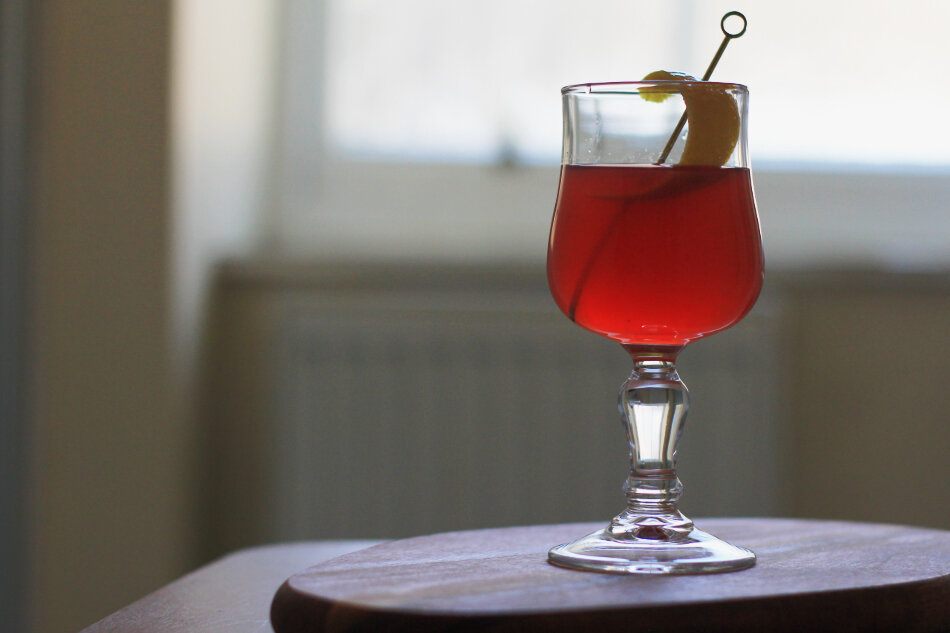
Valentine’s Day Massacre
45ml bourbon (I used Elijah Craig 12yr old)
15ml Campari
15ml sweet vermouth (I used Lillet Rouge)
4 raspberries
15ml lemon juice
Shake all ingredients with ice and fine-strain into a chilled martini glass. Garnish with a raspberry and a lemon zest twist.
The delicate art of the twist

There’s one phrase you can guarantee that you’ll hear at a cocktail competition. It’s the one that starts, “This drink is a twist on…” The concept of modifying an existing recipe and presenting it as a new drink isn’t new – look at the sheer volume of gin/vermouth/bitters recipes in the Savoy Cocktail Book, for example – but there’s a point at which we should ask where the boundaries lie.
This question – what constitutes a “twist”? – solidified for me at the Drambuie UK Cocktail Competition last month. I’d managed to sneak through the heat with an original recipe, but I’d be required to present both that drink and a twist on a Rusty Nail in the final. It’s not unusual for brands to ask competitors to present a modified version of one of their signature cocktails but the Rusty Nail struck me as one of the most difficult to change.
The problem is its simplicity. It has equal measures of two ingredients – Scotch and Drambuie – stirred and served on the rocks. There’s nothing in the recipe that can be pared down or outright removed without changing the nature of the drink. So, if I view those two ingredients as fundamental to my version remaining a Rusty Nail, the only thing I can do is add ingredients.
That created its own problems. Once again, I felt that adding too many ingredients would detract from the simplicity of the original formula. Adding a souring agent didn’t seem appropriate, nor did overly lengthening the drink. After sifting through combinations of complementary flavours, I ended up doing very little. I added a measure of apple juice to counteract the thick texture of the Drambuie and flamed a couple of sprays of Absinthe inside the glass to add a striking aroma.
The flipside to the approach I took was that it could be viewed as unadventurous and subsequently wasn’t far enough removed from a standard Rusty Nail. Having seen my scores (which is a rarity in competitions) I guess that’s the view that the judges took. It’s hard to argue with the decision, and I came away knowing what things I need to work on for future competitions, but the question’s still there. What constitutes a twist?
The Rust of Ages
30ml Drambuie
20ml blended Scotch whisky
30ml apple juice
10ml Absinthe (in atomiser)
Flamed a couple of sprays of absinthe into a small, chilled cocktail glass. Stir the other ingredients with ice and strain into the absinthe-rinsed glass.
This week's depressing alcohol consumption statistic

I definitely did not have all of my share of vodka last year.
- This is a couple of week’s old now, but a new study has suggested that the average consumption of alcohol in Scotland runs to 46 bottles of vodka a year – per person. Of course, there are there are those wh remain unconvinced.
- Continuing the social responsibility theme, SF/futurist blog io9 touches on why drinking while pregnant is bad (DNA mutations aren’t as awesome as the X-Men would have us believe, apparently) while the New York Times’ City Room blog looks at a younger crowd appearing in the Big Apple’s bars.
- Minimum pricing is the concept that won’t go away, but will it work?
- Cocktail Virgin Slut rounds up the 30+ entries for this month’s MxMo.
MxMo: Tea
Barfolk like to party, right? Get a couple of us together, throw in a couple of bottles of booze, and just wait for the banter to kick in. We don’t even have to physically meet up, either. In fact, once a month, one little corner of this whole wide internet becomes our block party because, once a month, there’s a Mixology Monday. This month, Frederic and the crew over at Cocktail Virgin Slut have volunteered to provide those cool little bowls of snacky things, blankets for the overnighters and to cook us breakfast, just so long as we’ve had a good hard think about tea.
Tea Cup Pot by Eduardo Mueses on Flickr.
From Japanese tea ceremonies to a construction worker’s tea break, tea is part of daily life across the globe. The attraction of this strange, exotic, herbal brew was one of the threads that drew colonial interest across the Ural Mountains in deepest Asia, threads that would bind together into trade routes and empires. It can represent sophistication and tradition just as easily as it embodies the chosen beverage of the working man.
And so we come to cocktails. The path through craft mixology is characterized by the search for new ingredients to incorporate into the cocktail tradition and tea is a compelling candidate. Whether it’s a black, green or white tea, or indeed, any variation, tea can add complexity and depth to different styles of drink.
A demonstration, then. Take an existing recipe and tea it up. The basis for the drink is the Pearlescent, which has picked up a bit of press over recent weeks. The original recipe calls for vodka, orgeat, Maraschino liqueur and a lemon zest, shaken and served up. It’s a great drink in its own right, but it also offers room for maneuver when adding twists.
The first of these twists was to use gin – Beefeater 24, if only for the inclusion of Japanese sencha tea in its botanical mix. The second was to switch the Maraschino for Limoncello and the lemon twist for a grapefruit twist. The final change was the addition of an Earl Grey rinse. The end result still has the pleasing sweetness of the Pearlescent, but with the added bonus of the rich flavours from both the tea and the gin mingling with the other ingredients’ citrus and almond notes.
The Incandescent
75ml Earl Grey tea
50ml Beefeater 24
2 barspoons Limoncello liqueur
1 barspoon orgeat
1 grapefruit zest twist
Rinse a chilled martini glass with the tea. Shake the other ingredients (including the zest) with ice and fine-strain into the chilled, rinsed glass.
2010 with a blast (from the past, of course)
Disney – Illuminations – Reflectons (3) (explored) by Express Monorail on Flickr.
It’s a brand new year, rife with possibility. What to do? Where to start?
- How about last year? Minimum drink pricing is back on the agenda, with its predictable supporters and detractors. Some might see minimum pricing as a stealth tax against the poorest sections of society; others look at the estimated £900 that alcohol abuse costs every person in Scotland.
- How about further back? Like 200,000 years ago? Apparently the caveman lifestyle is all the rage – in NYC.
- The Bronx Beer Caves.
- The Washington Post on the indescribable taste – and expense – of cognac.
- Oh Gosh! on Mozart Dry – unsweetened chocolate spirit.
Fifty Two: Another Castle
And so this is Christmas, and what have I done? Back at the start of the year, I set out to post an original cocktail recipe here on the internet every week throughout 2009, and – a couple of missed weeks here and a couple of double posts there aside – so here we are. If I’m honest, the main idea behind the entire project was to force me to create content for the site. I’ve let blogs die before, usually through a lack of focus and discipline, so I thought that operating to a consistent framework would see what I started at ednbrg into something more substantial, something other than a half-finished idea gathering dust in the blind alleyways of the internet. When I started, I certainly didn’t see myself registering a domain and moving the entire operation into paid hosting. Then again, when I started, I didn’t see myself moving jobs halfway through the year.
2009 has probably been my most productive year as a bartender. I don’t have well-defined goals, but a first appearance at a national final of a cocktail competition is definitely progress and also makes a great response to everyone who tells me to get a proper job. This project has been an education. It’s forced me to broaden my thinking about mixed drinks and look further for inspiration. Throughout the year, I’ve gained that from the massed ranks of cocktail enthusiasts that can be found online – if there’s a link in the sidebar over there, then you’re in my RSS reader and I thank you for the good work you’re doing. I should also share some love with Liqurious for letting drinkgeeks show off the wonderful things they’ve found online (and driving 75% of my referred traffic…). While I’m not sure if the FDA care that much about me, I should point out that a decent amount of the products I’ve used during the course of the project was provided free of charge, either through sympathetic bar managers or from the brands themselves. Particular thanks are due to Abelha Cachaca, Maxxium UK, Diageo, and Bacardi Brown-Forman.
Slide Rule Detail by Dominic’s pics on Flickr.
This year in drinks has thrown up some interesting numbers – the most commonly used base spirit across the 52 recipes was vodka which featured in 20 drinks, though I’ve not made a distinction between flavoured and unflavoured vodkas. Next most popular was rum (10/52) ahead of brandy and gin (6/52 each) and a surprise top five slot for cachaca (5/52). Products also tended to bunch together – four of the five cachaca recipes came over a five week period in the summer and the effect was even more pronounced with liqueurs and modifying ingredients. I would often use a newly discovered ingredient with a variety of base spirits in a short space of time, hence there are clumps of recipes involving Edmond Briottet Creme de Mure, Fee Brothers Aztec Chocolate Bitters and Fernet Branca at various times of the year. The slight majority of drinks were of Embury’s Aromatic Type (27:25), with lemon juice just shading the Sour Type drinks over lime (12:9; one drink had both).
Of course, I’m writing this like it’s all over. It’s not, not yet. I’m not planning on stopping posting original recipes here through 2010, but I’m going to take some time to decide how I’m going to approach the coming year. Until then, however, I still owe one more drink.
Another Castle
45ml Bols Genever
20ml Drambuie
30ml apple juice
5ml absinthe (in an atomiser, I used La Fée Parisienne)
Using a lighter, flame the absinthe into a chilled martini glass. Stir the other ingredients with ice and strain into the chilled, absinthe-flamed glass. Garnish with a lemon zest twist.
Festive
custom bokeh – i love christmas by Adam Foster | Codefor on Flickr.
It’s the season of goodwill and a time to remember the birth of – wait, gifts?! Have a great Christmas!